Built to Match
Hardware
Boards tuned for the software, and software that runs perfectly well on hardware you already own.
We tune the kernel for the boards we build, to get the best out of that hardware. The same Cosinium operating system family boots a pocket appliance, a rack server, a desktop box and a cloud instance. Hardware doesn't just mean physical boxes, the same software runs in a container on a host you already have.
Appliances and boards
A bootable image that can be flashed to NVMe, HDD, USB, SD or eMMC. Dedicated images for each single board appliance, and all with minimal preparation to get started.
Virtual machines and cloud
One image serves QEMU, ESXi, cloud instances and real hardware. Autodetection of OpenStack, EC2, GCE, Azure or a seeded volume without any third-party agent.
Containers on a Linux host
A flat root filesystem imported into your container runtime of choice (Podman, Docker) and run privileged with host networking. Use it to add a real firewall to infrastructure you already have, or to put one in front of your VM and container workloads.
What the boards do
- Wireless access point with full visibility
- Simultaneous multi-frequency Wi-Fi, each band with its own channel width, SSID visibility and client isolation.
- 2.5 GbE PPPoE as the baseline
- Multi-gigabit ports are where consumer and small-business fibre has landed, and where stock software stacks start falling behind. Cosinium's PPPoE eXpress Path exists precisely because of that gap.
- 10 Gbps-class and beyond
- Integrated 10G boards are in the range, with the drivers and pin control work implemented in our own kernel tree where mainline has not caught up. Faster cards are supported with loadable modules.
- Or hardware you already own
- x86-64 and ARM64, on commodity servers, cloud instances and containers. Nothing about the software requires our boards.
What we do to the operating system
No installer and no package manager, with everything needed in a single binary distribution that burns straight to the boot device. A secure update swaps the whole image rather than patching packages.
- One kernel baseline everywhere
- The same Linux version across every board with per-board optimisations on top, where every required driver is built in.
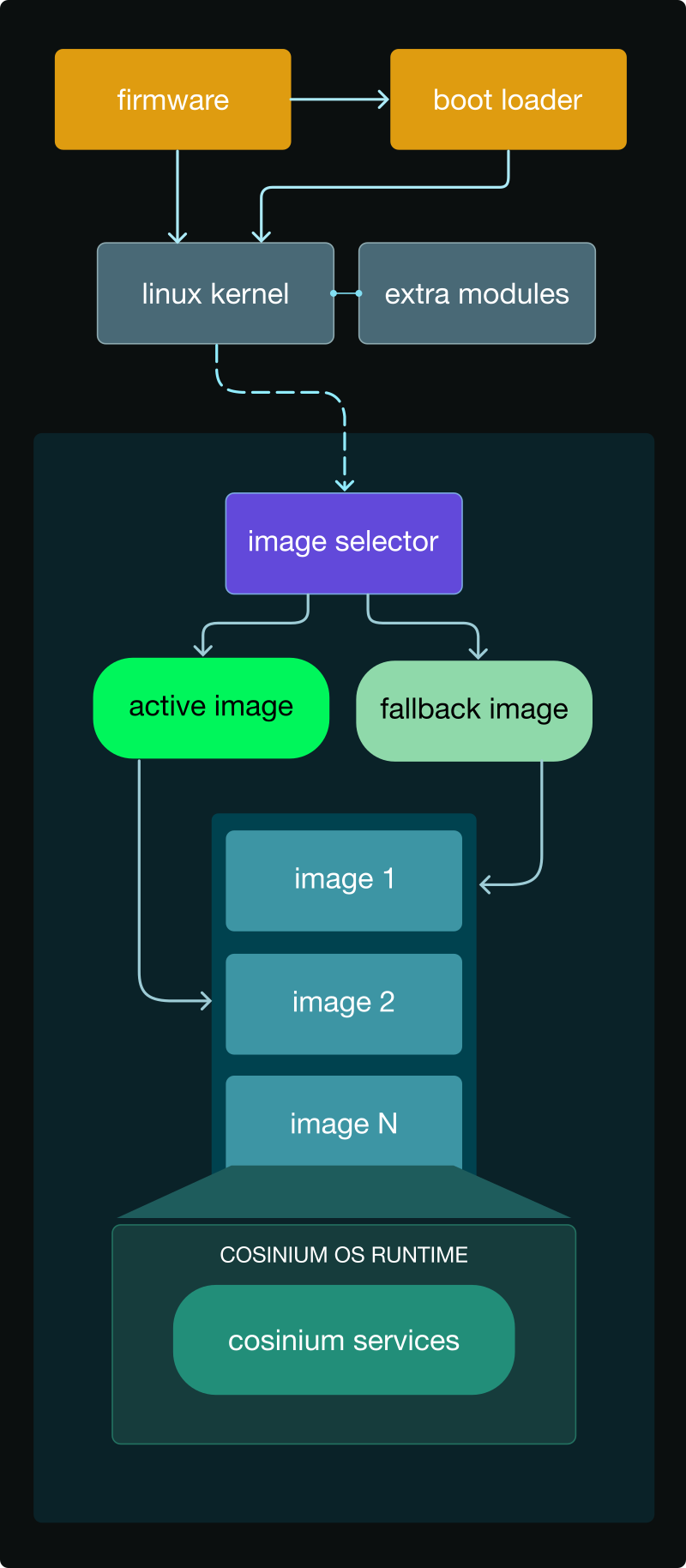
- Two layers, securely signed and updated independently
- An outer layer holds the kernel and an image selector that verifies signatures. An inner layer holds the Cosinium runtime and where all the software features run.
- Tuned kernel parameters
- Cosinium automates the tuning of kernel options to ensure that the optimal throughput and firewall processing is delivered by the hardware.
- Boot time treated as a bug surface
- Boot cycles are measured for unacceptable delays. When you power up Cosinium, it should be ready in seconds, not minutes.
The boards are in prototype
Our hardware is in prototype testing and the sales channel is still being worked out, so there are no model numbers or specifications to quote here yet.
If you want to run Cosinium now, run it on your own hardware or in your cloud. It is the same operating system on the same kernel baseline, so you give up nothing by not waiting for the boards. If you are still keen on our hardware, get in touch and we can work something out.